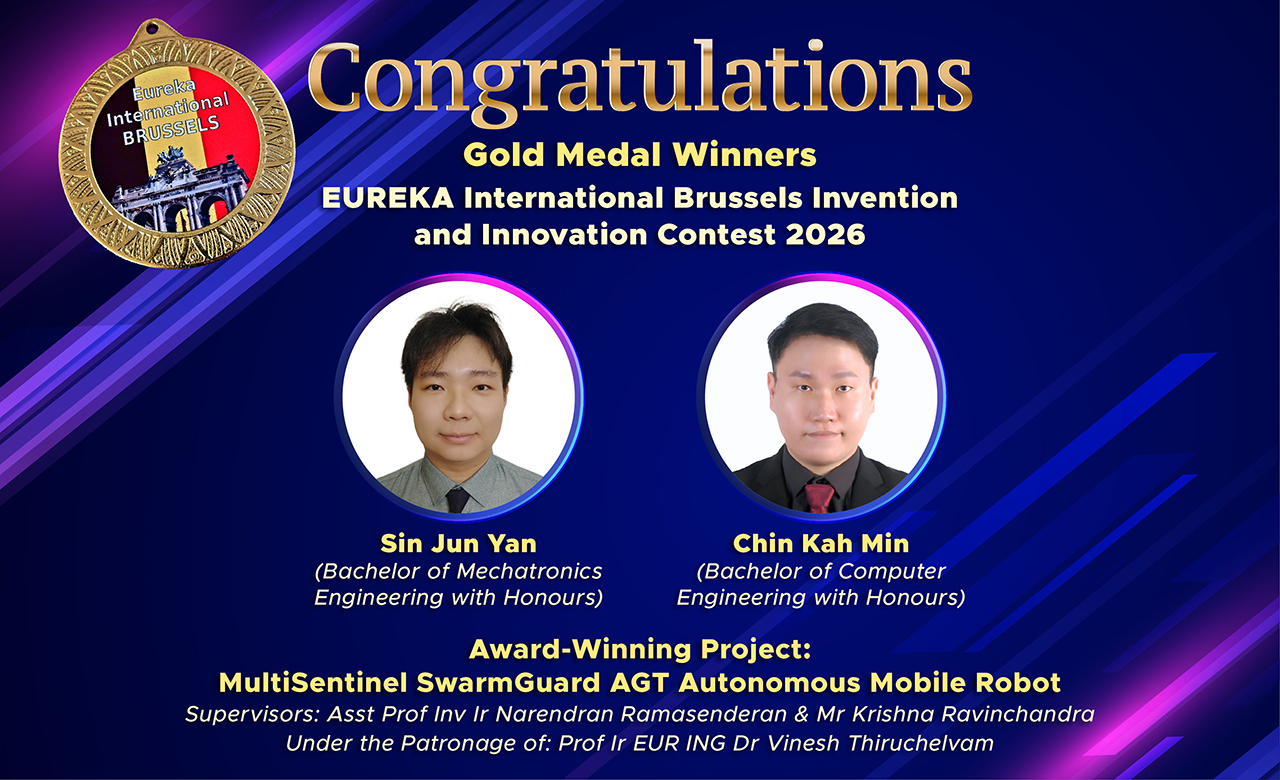
The Asia Pacific University of Technology & Innovation (APU) has secured one of the most prestigious recognitions on the global invention circuit.
At the EUREKA International Brussels Invention and Innovation Contest 2026, APU earned a Gold Medal through its student-led MultiSentinel SwarmGuard AGT Autonomous Mobile Robot — an AI-powered industrial inspection rover developed to address real-world industrial safety challenges.
Conceived within APU’s Centre of Excellence for Research and Development of Drone and IoT (CREDIT), the award-winning system was designed to operate in environments too hazardous for human workers, including semiconductor fabrication facilities, chemical plants, and ammonia-laden manufacturing environments.
Engineering Innovation Born from Industrial Reality
Unlike many academic prototypes developed purely for demonstration purposes, the SwarmGuard project originated from pressing operational challenges faced by Malaysia’s semiconductor and manufacturing sectors.
Hazardous chemical exposure, persistent workplace safety risks, and costly unplanned equipment downtime continue to pose major concerns across high-tech industrial environments.
In response, CREDIT developed the applied final-year research initiative to direct engineering education toward problems of genuine national and industrial significance.
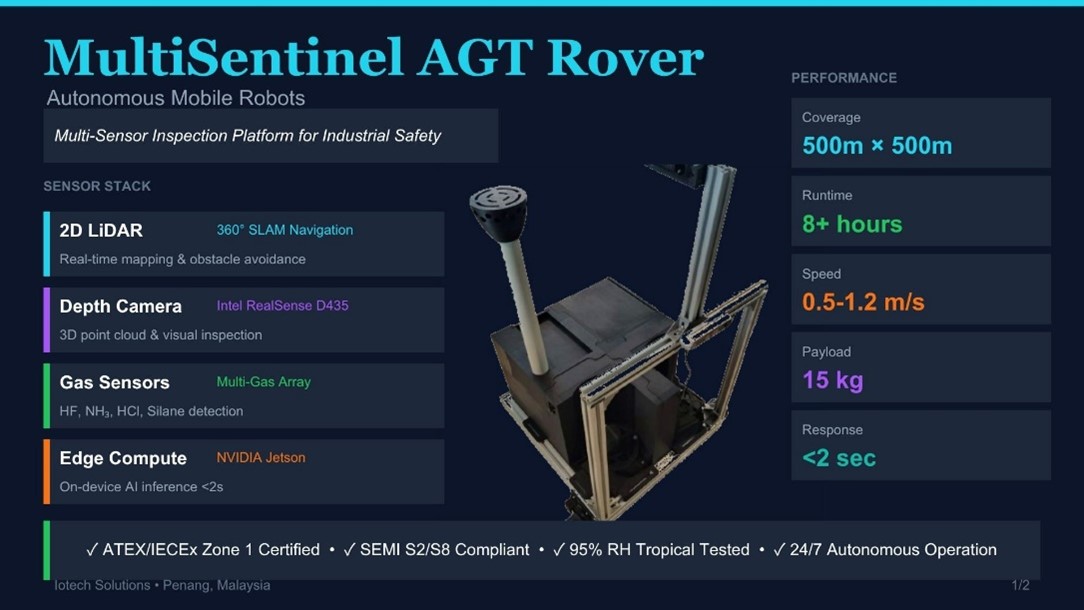
Built upon the SCUTTLE Autonomous Mobile Robot (AMR) platform and powered by ROS2 navigation architecture, the rover integrates a proprietary TriSense Detection suite that combines acoustic sensing, gas monitoring, and thermal analysis into a unified inspection ecosystem.
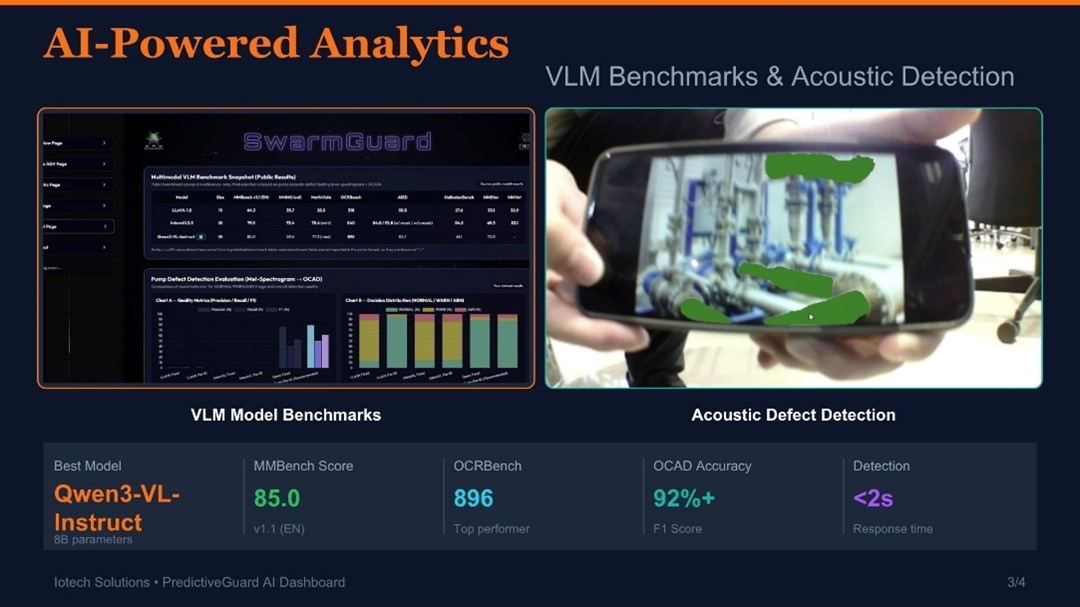
These sensing capabilities are further orchestrated through an advanced Vision-Language Model anomaly detection pipeline, enabling the system to identify irregularities, trigger intelligent alerts, and support predictive industrial maintenance.
Most importantly, the system is designed to significantly reduce direct human exposure to hazardous industrial conditions, with the platform capable of lowering worker exposure risks by up to 90 per cent.
A Cross-Disciplinary Partnership in Action
The project was driven through a deliberate cross-disciplinary collaboration between two Final Year Project (FYP) students from different engineering disciplines, reflecting APU’s emphasis on integrated problem-solving and interdisciplinary innovation.
Sin Jun Yan, a Bachelor of Mechatronics Engineering with Honours student, engineered the hardware-centric architecture of the system. His contributions included the dual-microphone acoustic array, multi-sensor integration framework, and the acoustic-triggered camera activation mechanism that enables intelligent environmental monitoring.
Complementing the hardware innovation, Chin Kah Min, a Bachelor of Computer Engineering with Honours student, developed the agentic AI framework and the OCAD software stack responsible for anomaly detection and autonomous analytical processing.
The project was supervised by Assistant Professor Inv Ir Narendran Ramasenderan, Head of CREDIT and Chief Executive Officer of IoTech Solutions, APU’s deeptech spinoff company, alongside Research Fellow Mr Krishna Ravinchandra. The initiative was conducted under the institutional patronage of Professor Ir EUR ING Dr Vinesh Thiruchelvam, APU’s Chief Innovation & Enterprise Officer.
Further extending its international success, the students’ FYP also earned global recognition at the International Idea, Novelty, Invention Exhibition and Fair (IDEA 2026). The innovation secured a Gold Medal Award and the prestigious Best International Invention Award, alongside two distinguished international special recognitions — a Special Award from Norton University and another from the Inventors College Organization — further underscoring the project’s global relevance and innovation excellence.
Advancing Sustainable and Safer Industries
Beyond its technical sophistication, the SwarmGuard platform also reflects broader sustainability and industrial transformation goals.
The innovation aligns directly with two United Nations Sustainable Development Goals (SDGs): SDG 9, Industry, Innovation and Infrastructure, through its contribution toward resilient and technology-driven industrial systems; and SDG 12, Responsible Consumption and Production, through its prevention of chemical incidents, reduction of equipment failure waste, and promotion of safer and more sustainable manufacturing practices.
By integrating AI, robotics, IoT sensing, and intelligent inspection capabilities into a deployable industrial platform, the project demonstrates how university-led research can contribute meaningfully to safer industrial ecosystems and future-ready manufacturing infrastructure.
Every Generation of Innovators Trains the Next
Crucially, the project does not conclude with the graduation of its creators.
In keeping with APU’s deeply embedded culture of knowledge transfer and mentorship, Chin Kah Min and Sin Jun Yan have already begun passing their expertise to a new generation of engineering students at CREDIT.
Through hands-on training sessions, they have guided juniors Harshayn Vythilingam and Gayatri Reshma Penjarla in areas ranging from hardware integration and ROS2 system architecture to the OCAD anomaly detection pipeline and autonomous robotics development.
This continuity ensures that the SwarmGuard platform will continue evolving through successive student cohorts, allowing future researchers and innovators to refine, expand, and potentially commercialise the technology further.
Within CREDIT, this culture has become a defining tradition: every generation of innovators trains the next.
Building a Pipeline of Internationally Recognised Innovation
The Gold Medal victory in Brussels further strengthens CREDIT’s growing international reputation in advanced engineering and deep technology research.
From 2025 to 2026 alone, the centre has accumulated more than 34 international awards, alongside over 37 active intellectual property filings, more than 60 research publications, and over RM300,000 in cloud research grants.
More significantly, the achievement reinforces a defining institutional philosophy at APU: that final-year projects are not academic exit rituals, but launchpads for international recognition, protected intellectual property, and commercially relevant industrial impact.
From lecture hall to laboratory, from laboratory to launchpad, and now from Kuala Lumpur to Brussels, APU’s innovation ecosystem continues to nurture talent capable of addressing real-world challenges — generation after generation.
News & Happening
Download e-Brochures
Intake Calendar
Want to know more ?
Let’s Connect