Course Details


Why choose APU?




Dual Degree
APU-DMU Dual Degree Programme

Postgraduate Scholarships
Scholarships Available
Up to 30% Merit Scholarship | 15% APEL A entry pathway.
Requirements
Entry Requirements
Applied Psychology (non-practitioner):
- Bachelor’s degree in Psychology with a minimum CGPA of 2.50, or its equivalent qualification as accepted by the Senate.
- Bachelor’s degree in Psychology with a minimum CGPA of 2.00 and not meeting a CGPA of 2.50 can be accepted, subject to a rigorous internal assessment.
- Bachelor’s degree in non-related fields with a minimum CGPA of 2.50 with a minimum 45 credits of prerequisites modules in Psychology or a graduate diploma in Psychology or its equivalent as accepted by accepted by the Senate.
- Bachelor’s degree in non-related fields with a minimum CGPA of 2.50 and a Master’s degree in Psychology with a minimum 45 credits of prerequisites modules in Psychology or a graduate diploma in Psychology or its equivalent as accepted by the Senate.
- Other relevant equivalent qualifications recognised by Malaysian government as equivalent to the above requirements
* Rigorous internal assessment may include independent panel interview, GRE psychology examination, and relevant extensive experience.
**Applicants without a Psychology-related Bachelor’s degree must pass the pre-requisite modules (45 credits) to continue with the Master’s Degree.
Note: The above entry requirements may differ for specific programmes based on the latest programme standards published by Malaysian Qualifications Agency (MQA).
- IELTS : 5.5
What We Teach
This programme is specifically designed to provide:
- Digital Mind & Behavior: Build a deep understanding of how digital spaces - like social media, AI, and virtual reality - shape human thoughts, identity, and actions.
- Cybersecurity & Online Risks: Gain practical insights into real-world digital issues, including online deception, internet safety, cyber forensics, and digital well-being.
- Data & Research Skills: Master advanced tools in data analysis, psychology testing, and both quantitative and qualitative research built for digital environments.
- Ethics & Hands-On Practice: Learn to navigate ethical challenges like algorithmic bias and data privacy, then apply these skills in a real-world internship and research project.
-
The Benefits of the Programme
- First-Mover Advantage: Join one of the few specialised postgraduate programmes in Asia that directly addresses the intersection of psychological science and the "Human 5.0" digital landscape.
- Comprehensive Core-to-Elective Pipeline: Balance essential psychological foundations (Ethics, Research Methods, Psychometrics) with cutting-edge specialisation tracks like Forensic Cyberpsychology and Workforce Mental Health.
- Industry-Aligned Practicum: Gain direct, supervised professional experience, allowing students to apply cyberpsychological theories to actual organisational or community challenges.
- Dual-Perspective Competency: Develop a unique dual fluency - understanding both the psychological needs of the user/employee and the technical architecture of the digital platforms they inhabit.
- Future-Proof Skillset: Acquire highly transferable skills in behavioral data analysis, digital risk mitigation, and ethical AI implementation that remain resilient to rapid technological shifts.
-
Who Should Attend
This programme is meticulously designed for ambitious professionals and graduates aiming to pioneer the next frontier of behavioural science:
- Psychology & Social Science Graduates: Individuals holding a bachelor’s degree in psychology, counseling, or related disciplines who want to specialise in the rapidly expanding domain of cyberspace and digital behavior.
- Tech & Design Professionals: UX/UI researchers, product managers, software developers, and AI designers who want to deeply understand the psychological impact of their tech designs and optimise user engagement ethically.**
- Cybersecurity & IT Specialists: Professionals looking to master the "human element" of cybersecurity, understanding social engineering, insider threats, and the cognitive load of tech teams.**
- HR & Corporate Wellness Managers: People operations professionals tasked with managing remote workforces, digital burnout, and the overall mental well-being of a highly digitised workforce.
- Law Enforcement & Policy Professionals: Analysts, legal professionals, and policy makers aiming to understand digital deception, cybercrime behavioural, and national digital health frameworks.**
** Applicants without a Psychology-related Bachelor’s degree must pass the pre-requisite modules (45 credits) to continue with the Master’s Degree. -
Modules & Practicum
This programme includes 10 modules: 9 coursework modules and 1 practicum.
Core Modules
- Core Concepts of Cyberpsychology
- Research Methods & Statistics
- Ethical and Professional Issues in Psychology
- Mental Health of Cyber Workforce
- Psychometric Testing
- Research Project
- Forensic Cyberpsychology
- Practicum
Elective Modules (Choose 2)*
- Cyberpsychology of Deception OR Consumer & Media Cyberpsychology
- Cybercognition & Behaviour OR Social Psychology in Cyberspace
* Elective modules may be pre-selected. If students wish to change these pre-selected elective modules, they can choose from the available modules offered in the timetable OR among the intensive delivery modules - however such changes may prolong the study duration.
-
Practicum
Practicum equips students with essential skills for career growth in digital intervention design, online behavior training, and technological psychological development. Students will apply their knowledge in a chosen digital, clinical, research or corporate setting - designing, delivering, and reflecting on a cyberpsychology based initiative or session. They will receive professional supervision and feedback, using it to continuously improve and achieve key industry competencies in applied cyberpsychology.
Academic Partnership
University of Sydney, Australia & De Montfort University, Leicester UK.
This programme was designed in collaboration with the Cyberpsychology Research Group, University of Sydney, Australia & De Montfort University, Leicester UK.


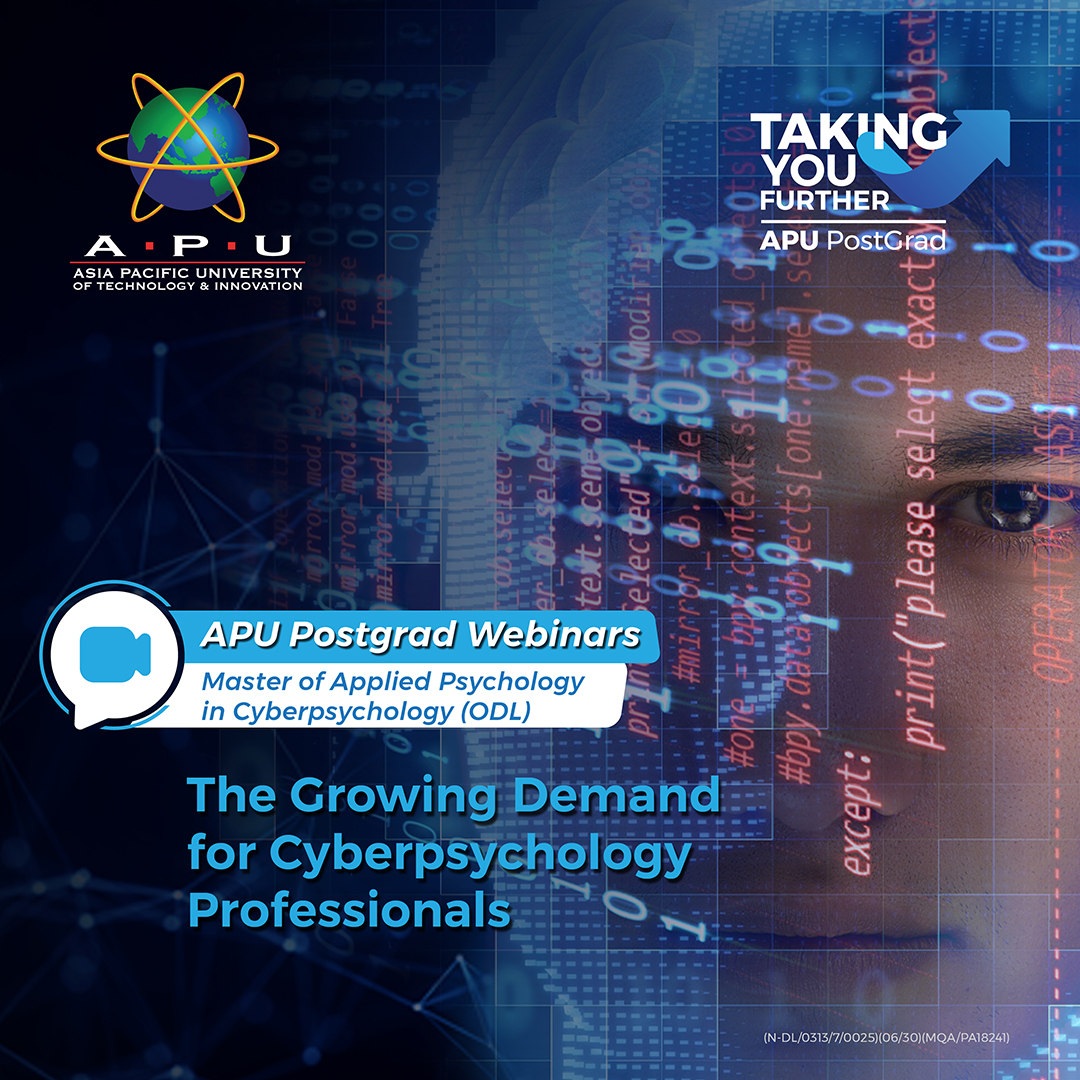
APU Postgraduate Webinar (Recorded)
The Growing Demand for Cyberpsychology Professionals
Discover how the Master of Applied Psychology in Cyberpsychology (ODL) can prepare you for an exciting future where Psychology, Technology, and Digital Innovation come together.
100% Online
Open & Distance Learning (ODL)
- The ODL (Open & Distance Learning) programmes are designed to address the theoretical, practical and scientific skills and contribute towards new and meaningful knowledge in their field of expertise.
- ODL allows students to learn anytime, anywhere at their own pace - this power of freedom has ignited more interest & excitement in learning.
- All the Master (ODL) programmes are available for part-time study mode. The minimum duration of study is 2.5 years.
- Students are to register the modules on a modular basis. Each module will be offered over a two-month duration.
Facilities at APU
The APU Centre Point & Atrium serves as a melting pot of cultures from all over the world. Here, cultural activities are organised regularly at the campus, fostering long-lasting intercultural relationships among APU students, who come from over 130 countries.
Ready, Set, Go.
Whether you are locals or traveling here, we have the options for you to pursue your dreams.
RM33,000
Total for Malaysian
Special Fees for 2026 Intakes: RM26,400
RM33,000
(USD8,685)
Total for International
Special Fees for 2026 Intakes: RM26,400 (USD6,950)
Programme code : (N-DL/0313/7/0025)(06/30)(MQA/PA18241)
All information is correct at the time of publication, but is subject to change in the interest of continuing improvement.
Note : All fees are payable in Ringgit Malaysia (RM). Any USD amounts indicated by APU are for reference only and are non-binding. The final amount payable is the RM amount stated in the official invoice, and the University will not entertain any claims arising from foreign exchange fluctuations.

Postgraduate Studies
Learn More
Awards & Recognitions
Learn MoreAPEL.C
Online Learning
Facilities
Want to know more ?
Let’s Connect